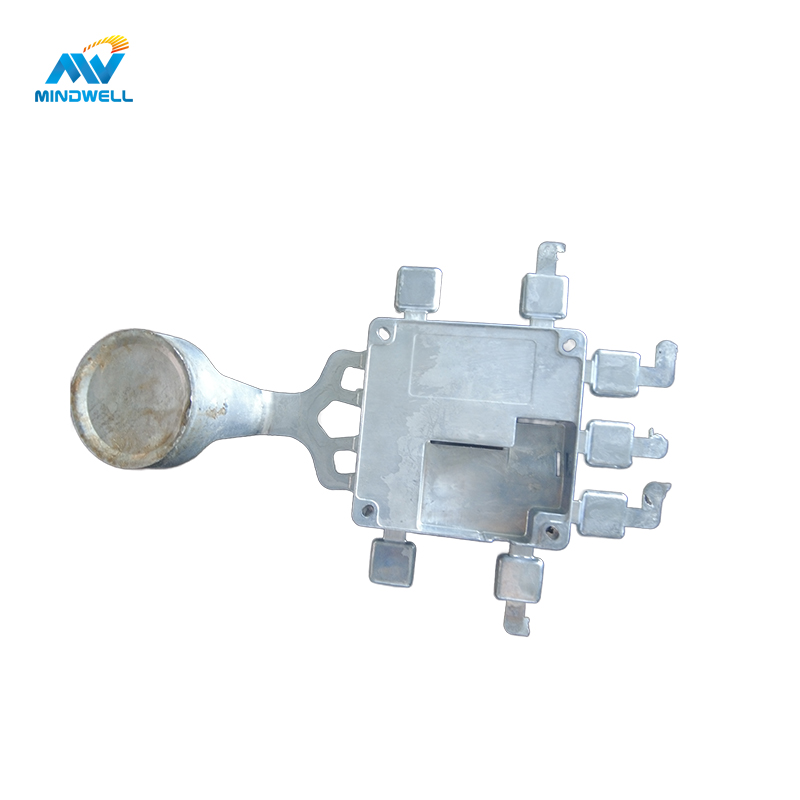
A finished-part drawing alone is not a die-casting RFQ.
It leaves the supplier guessing where to add machining stock, and how much.
This page is buyer education for sourcing and engineering teams preparing a die-casting RFQ that includes post-cast machining. It is not a stock table, not a fixture or production drawing, and not a company capability sheet.
Show both states
Show both states: an as-cast drawing plus a finished one, or one view with the cast outline and stock marked on each machined face.
Name the first-cut locators, then agree stock face by face
Before you pick the stock, name the first-cut as-cast locators. In the sketch, that’s the R pads and the S face. Stock only makes sense relative to those references. Agree the allowance face by face, not as one number for everything.
Write the datum shift into the RFQ
Those locators are not the finished datums. Locate on R and S, machine A, then relocate on A to create B. Write that shift into the RFQ, and when later setups switch to the finished set.
For bores, say radial or on diameter
For bores and turned diameters, write “radial” or “on diameter.”
Keep die-cast stock modest
Keep die-cast stock modest, but enough to clean up reliably. A deep cut can break through the dense outer skin and expose porosity on a sealing face. More stock is not automatically safer.
The sketch
The figure is a teaching aid for the points above.

The sketch is a concept. Stock gaps are exaggerated. It is not to scale, not a complete fixture layout, and not a production drawing or customer part. Do not take the enlarged gold stock areas as a real allowance.
Next step
For more on MINDWELL: mnwell.com